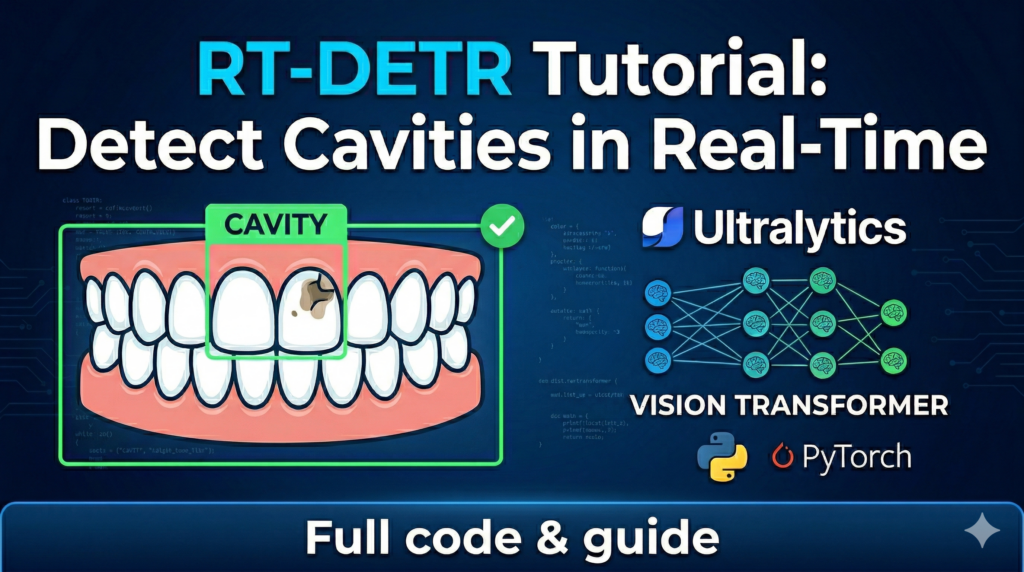
How to Build Dental Cavity Detection AI with RT-DETR / Object Detection, Pytorch, VIT Contents hide 1 Why Dental Cavity Detection AI is a Game-Changer for Modern Clinics 2 Setting Up Your Neural Network for Dental Diagnostics 2.1 Why choose RT-DETR over standard YOLO models for this project? 2.2 Master Computer Vision 3 How to Build Dental Cavity Detection AI with RT-DETR 4 Building Your Digital Foundation with Python 3.12 4.1 Why is using a Conda environment specifically for Python 3.12 important for AI? 5 Unleashing Hardware Power with CUDA and PyTorch 5.1 What happens if I install the wrong version of PyTorch for my CUDA drivers? 6 Integrating the Ultralytics Transformer Core 6.1 Is the Ultralytics library only for YOLO models? 7 Training Your Dental Cavity Detection AI Model 7.1 What is the role of the ‘patience’ parameter in the model training process? 8 Structuring the Dental Dataset for Success 8.1 Generate data.yaml file 8.2 Why do we need to specify separate paths for ‘train’, ‘val’, and ‘test’? 9 Running Your First AI Dental Diagnostic Inference 9.1 How does the confidence ‘threshold’ affect the cavity detection results? 10 FAQ 10.1 What is RT-DETR and how does it differ from YOLO? 10.2 Why is Python 3.12 recommended for this tutorial? 10.3 How much VRAM do I need to train the RT-DETR-L model? 10.4 What are the main classes detected in this Dental AI project? 10.5 Does this model require Non-Maximum Suppression (NMS)? 10.6 How do I verify if my GPU is correctly being used for training? 10.7 What is the purpose of the patience=10 parameter? 10.8 Can I use this code for real-time video inference? 10.9 Why compare Predicted results with Ground Truth? 10.10 How can I further optimize the model for clinical use? 11 Conclusion 11.1 Connect : Last Updated on 28/07/2026 by Eran Feit By Eran Feit — Computer Vision engineer and educator with 10+ years in deep learning. Integrating artificial intelligence into the world of dentistry is no longer a concept confined to academic papers; it is becoming a critical tool for diagnostic accuracy in modern clinics. This guide focuses on the practical implementation of Dental Cavity Detection AI, leveraging the latest advancements in real-time object detection to identify pathologies in X-ray and intraoral imagery. By transitioning from traditional convolutional architectures to transformer-based models, we can achieve a level of precision that was previously difficult to maintain in high-stakes medical environments. Readers will find immense value here because we are moving beyond the “one-size-fits-all” approach of standard object detectors. In the medical field, a false negative can lead to untreated decay, while a false positive results in unnecessary procedures. This tutorial addresses these challenges by utilizing RT-DETR (Real-Time Detection Transformer), a model designed to handle complex spatial relationships within an image without the architectural bottlenecks found in older systems. This RT-DETR Tutorial will walk you through the entire lifecycle of a medical AI project, from the initial environment configuration to the final inference logic. We will deep-dive into the technical nuances of the Ultralytics framework, demonstrating how to properly structure a dental dataset and fine-tune a transformer model specifically for identifying varied cavity types. You won’t just see the theory; you will see the exact Python implementation required to turn raw images into actionable diagnostic data. Ultimately, the goal is to bridge the gap between “code that runs” and “code that solves problems.” By the end of this post, you will have a functional pipeline capable of detecting dental issues with high confidence. We will explore how to interpret the model’s predictions alongside ground truth labels, ensuring that your Dental Cavity Detection AI isn’t just fast, but clinically relevant and reliable for real-world digital health applications. Why Dental Cavity Detection AI is a Game-Changer for Modern Clinics The primary target for Dental Cavity Detection AI spans a broad spectrum, from software developers building the next generation of dental imaging suites to practitioners looking for a “second set of eyes” during patient consultations. Human fatigue is a real factor in radiology; after reviewing dozens of X-rays in a single day, subtle demineralization or early-stage proximal cavities can easily be overlooked. An AI-driven system acts as a persistent, objective assistant that flags areas of concern, ensuring that no patient leaves the chair with an undiagnosed issue. At a high level, this technology works by training a neural network to recognize the specific visual signatures of dental decay—such as dark shadows, irregular radiolucencies, and structural gaps in the enamel—within digital radiographs. Unlike traditional software that might use simple thresholding, modern Dental Cavity Detection AI understands the context of the entire tooth structure. It differentiates between natural grooves, existing fillings, and active decay, providing a probabilistic score that helps the clinician decide whether to monitor the site or intervene immediately. Implementing this via a real-time transformer model like RT-DETR represents a significant leap forward in how we process medical data. Because the model processes the image globally rather than through a sliding window or local anchors, it is much better at understanding the relationship between different teeth and the surrounding bone structure. This leads to a more robust diagnostic tool that can handle the “noise” often found in dental X-rays, such as overlapping teeth or varying exposure levels, making the transition to digital-first dentistry smoother and more accurate for everyone involved. Subscription FormSend me tutorials Dental Cavity Detection AI Setting Up Your Neural Network for Dental Diagnostics Transitioning from theoretical AI to a functional medical tool requires a robust and specific codebase. The primary target of this implementation is to provide a seamless, end-to-end pipeline that takes raw dental X-rays and transforms them into diagnostic insights through the power of RT-DETR. By focusing on a “Real-Time Detection Transformer,” we bypass the traditional complexities of non-maximum suppression, allowing the model to make direct, high-precision predictions. This code is designed for high-stakes environments where accuracy and speed are non-negotiable, offering a streamlined path for developers to deploy high-fidelity Dental Cavity Detection AI. At its core, the script manages three critical phases: environment synchronization, custom training, and visual inference. The initial setup ensures that your hardware—specifically your GPU through CUDA—is perfectly aligned with the Python 3.12 environment and the Ultralytics framework. This foundation is vital because medical imaging datasets often require high computational throughput, and a mismatched library version can lead to subtle errors in gradient descent or image tensor processing during the RT-DETR Tutorial walk-through. Why choose RT-DETR over standard YOLO models for this project? While YOLO models are excellent for general object detection, RT-DETR uses a transformer-based architecture that views the dental image as a global sequence rather than a grid of local cells. This allows the AI to better understand the relationship between different teeth and the surrounding bone structure, leading to fewer false positives and a more reliable Dental Cavity Detection AI output in complex clinical scenarios. The training logic within the code utilizes a data.yaml configuration to bridge the gap between your local file system and the neural network. By pointing the model to specific “train,” “validation,” and “test” directories, we create a rigorous evaluation loop. During the 100-epoch training process, the model isn’t just memorizing pixel patterns; it is learning to identify the nuanced radiolucency that defines a cavity versus the dense, bright signals of healthy enamel or artificial crowns. Finally, the inference and visualization portion of the code is where the “black box” of AI becomes transparent. We don’t just output a list of coordinates; we map those coordinates back onto the original image using OpenCV to create a visual overlay. This allows the user to compare the “Ground Truth”—what a human expert has labeled—against the “Predicted” result. This comparison is the ultimate validation of the Dental Cavity Detection AI, providing a clear visual audit trail that is essential for building trust in digital health applications. The script also handles coordinate conversion from the normalized YOLO format to pixel-based rectangles. This is a crucial step in this RT-DETR Tutorial, as it ensures that the bounding boxes align perfectly with the high-resolution dental scans. By the time the code finishes executing, it saves a side-by-side comparison that proves the model’s efficacy, turning complex mathematical weights into a clear, visual diagnostic tool that any dental professional can interpret at a glance. Link to the video tutorial here . Download the code for the tutorial here or here TRY IT NOW Master Computer Vision Follow my latest tutorials and AI insights on my Personal Blog. Beginner Complete CV Bootcamp Foundation using PyTorch & TensorFlow. Get Started → Interactive Deep Learning with PyTorch Hands-on practice in an interactive environment. Start Learning → Advanced Modern CV: GPT & OpenCV4 Vision GPT and production-ready models. Go Advanced → Real-time Detection Transformer How to Build Dental Cavity Detection AI with RT-DETR Download the code … Integrating artificial intelligence into the world of dentistry is no longer a concept confined to academic papers; it is becoming a critical tool for diagnostic accuracy in modern clinics. This guide focuses on the practical implementation of Dental Cavity Detection AI, leveraging the latest advancements in real-time object detection to identify pathologies in X-ray and intraoral imagery. By transitioning from traditional convolutional architectures to transformer-based models, we can achieve a level of precision that was previously difficult to maintain in high-stakes medical environments. Readers will find immense value here because we are moving beyond the “one-size-fits-all” approach of standard object detectors. In the medical field, a false negative can lead to untreated decay, while a false positive results in unnecessary procedures. This tutorial addresses these challenges by utilizing RT-DETR (Real-Time Detection Transformer), a model designed to handle complex spatial relationships within an image without the architectural bottlenecks found in older systems. This RT-DETR Tutorial will walk you through the entire lifecycle of a medical AI project, from the initial environment configuration to the final inference logic. We will deep-dive into the technical nuances of the Ultralytics framework, demonstrating how to properly structure a dental dataset and fine-tune a transformer model specifically for identifying varied cavity types. You won’t just see the theory; you will see the exact Python implementation required to turn raw images into actionable diagnostic data. Ultimately, the goal is to bridge the gap between “code that runs” and “code that solves problems.” By the end of this post, you will have a functional pipeline capable of detecting dental issues with high confidence. We will explore how to interpret the model’s predictions alongside ground truth labels, ensuring that your Dental Cavity Detection AI isn’t just fast, but clinically relevant and reliable for real-world digital health applications. Building Your Digital Foundation with Python 3.12 Creating a clean, isolated workspace is the first step in ensuring your Dental Cavity Detection AI project runs without library conflicts. By using Conda, we encapsulate all the specific versions of Python and dependencies required for this transformer-based model. This practice is essential for professional development, as it allows you to switch between different AI projects without breaking your global system settings. In this section, we initialize a dedicated environment named YoloV11-312. We specifically choose Python 3.12 to take advantage of the latest performance optimizations and security patches available in the ecosystem. Once the environment is created, activating it ensures that every subsequent pip install command is contained within this specific project “bubble.” Why is using a Conda environment specifically for Python 3.12 important for AI? Using a Conda environment with Python 3.12 ensures that your RT-DETR Tutorial remains stable by isolating the specific interpreter and libraries needed, preventing “dependency hell” where one project’s updates break another’s functionality. ### Create a Conda environment with Python 3.12 conda create -n YoloV11-312 python=3.12 ### Activate the newly created environment conda activate YoloV11-312### Create a Conda environment with Python 3.12 conda create -n YoloV11-312 python=3.12 ### Activate the newly created environment conda activate YoloV11-312 Mastering Computer Vision Setup How to Implement RT-DETR in Python with Ultralytics A fundamental look at the RT-DETR architecture and why it is replacing traditional models in specialized vision tasks. FasterViT Image Classification Using Custom Dataset Learn how to handle custom datasets with Vision Transformers, a great precursor to training RT-DETR. Unleashing Hardware Power with CUDA and PyTorch To achieve the “Real-Time” performance promised by RT-DETR, we must offload the heavy mathematical computations to your NVIDIA GPU. Checking your CUDA version is a mandatory step; it tells the system how to communicate with your graphics card hardware effectively. Without this alignment, the training process for your Dental Cavity Detection AI would be prohibitively slow on a standard CPU. We then proceed to install PyTorch v2.9.1 paired with CUDA 12.8. This specific combination is highly optimized for the Transformer layers used in the RT-DETR architecture, ensuring that image tensors flow through the network with minimal latency. By using the specialized index-url, we tell pip to ignore the generic CPU versions and grab the high-performance binaries built for your specific GPU architecture. What happens if I install the wrong version of PyTorch for my CUDA drivers? Installing an incompatible PyTorch version will typically lead to the code defaulting to CPU execution, which will make your Dental Cavity Detection AI training significantly slower and potentially cause memory errors. ### Check the current CUDA compiler version on your system nvcc --version ### Install PyTorch 2.9.1 with CUDA 12.8 support pip install torch==2.9.1 torchvision==0.24.1 torchaudio==2.9.1 --index-url https://download.pytorch.org/whl/cu128### Check the current CUDA compiler version on your system nvcc --version ### Install PyTorch 2.9.1 with CUDA 12.8 support pip install torch==2.9.1 torchvision==0.24.1 torchaudio==2.9.1 --index-url https://download.pytorch.org/whl/cu128 Integrating the Ultralytics Transformer Core The heavy lifting of our RT-DETR Tutorial is managed by the Ultralytics framework, which has evolved into a powerhouse for both YOLO and Transformer models. Installing the exact version 8.4.21 ensures that you have access to the latest RT-DETR-L architecture while maintaining compatibility with the code structure provided below. This library simplifies complex tasks like data augmentation and loss calculation into a few lines of Python. By integrating this core, we gain access to the RT-DETR-L (Large) model, which strikes a perfect balance between speed and precision. In the context of Dental Cavity Detection AI, the ‘Large’ variant is often preferred over ‘Small’ because dental features are subtle and require a deeper network to distinguish between healthy enamel and early-stage decay. The installation is quick, but it sets the stage for the advanced transformer logic that follows. Is the Ultralytics library only for YOLO models? No, the Ultralytics library has expanded to support state-of-the-art transformers like RT-DETR, making it a versatile tool for implementing high-accuracy Dental Cavity Detection AI projects. ### Install the Ultralytics framework for model management and training pip install ultralytics==8.4.21### Install the Ultralytics framework for model management and training pip install ultralytics==8.4.21 Ultralytics RT-DETR Custom Training Training Your Dental Cavity Detection AI Model This is where the magic happens: turning raw code into a diagnostic expert. We initialize the RT-DETR-L model and point it toward our dental dataset via the data.yaml configuration file. Setting epochs=100 allows the model sufficient time to converge, while the patience=10 parameter ensures that the training stops automatically if the model ceases to improve, saving you time and electricity. The imgsz=640 parameter is a standard resolution that preserves enough detail in dental X-rays for the transformer to detect small cavities. By directing the output to a specific project folder, we keep our experimental results organized, allowing us to easily locate the best.pt file—the final “brain” of our Dental Cavity Detection AI. Running this on device=0 ensures that your primary GPU is doing all the work at maximum efficiency. What is the role of the ‘patience’ parameter in the model training process? The patience parameter acts as an early-stopping mechanism that monitors the validation loss; if the Dental Cavity Detection AI stops improving for 10 consecutive epochs, it halts training to prevent overfitting. from ultralytics import RTDETR import cv2 if __name__ == "__main__": ### Load the RT-DETR-L pretrained transformer model model = RTDETR("rtdetr-l.pt") ### Start training the model on the dental cavity dataset results = model.train(data="Best-Object-Detection-models/Ultralytics - Transformer (RT-DETR)/Train-Custom-model-Dental-Cavity/data.yaml", epochs=100, imgsz=640, batch=16, patience=10, save=True, device=0, project="d:/temp/Models/RT-DETR-Cavity", name="Dental-Cavity", val=True)from ultralytics import RTDETR import cv2 if __name__ == "__main__": ### Load the RT-DETR-L pretrained transformer model model = RTDETR("rtdetr-l.pt") ### Start training the model on the dental cavity dataset results = model.train(data="Best-Object-Detection-models/Ultralytics - Transformer (RT-DETR)/Train-Custom-model-Dental-Cavity/data.yaml", epochs=100, imgsz=640, batch=16, patience=10, save=True, device=0, project="d:/temp/Models/RT-DETR-Cavity", name="Dental-Cavity", val=True) Advanced AI Segmentation Strategies Interactive SAM2 Segmentation: Points, Boxes, and Masks Discover how to use Segment Anything Model 2 to refine medical masks, a perfect companion for RT-DETR outputs. How To Perform Florence-2 Segmentation On Images A look at Microsoft’s Florence-2 for advanced medical image understanding and text-to-segmentation tasks. Structuring the Dental Dataset for Success Generate data.yaml file The data.yaml file is the architectural blueprint for your Dental Cavity Detection AI. It tells the model exactly where to find the training, validation, and testing images on your hard drive. Without this clearly defined structure, the RT-DETR model wouldn’t know how to evaluate its own progress during the training loop. We define two classes: cavity and normal. This binary classification is fundamental for a RT-DETR Tutorial in medical imaging, as it forces the model to learn the specific features of healthy versus unhealthy teeth. The absolute paths used in this configuration ensure that the script can find your data regardless of which directory you are running your Python code from. Why do we need to specify separate paths for ‘train’, ‘val’, and ‘test’? Separating these paths ensures that the Dental Cavity Detection AI is trained on one set of data and validated on another, preventing the model from simply “memorizing” images instead of learning general diagnostic features. ### Path to the training image directory train: D:/Data-Sets-Object-Detection/Dental cavity/train/images ### Path to the validation image directory val: D:/Data-Sets-Object-Detection/Dental cavity/valid/images ### Path to the testing image directory test: D:/Data-Sets-Object-Detection/Dental cavity/test/images ### Number of classes in the dataset nc: 2 ### Human-readable names for each class index names: ['cavity','normal']### Path to the training image directory train: D:/Data-Sets-Object-Detection/Dental cavity/train/images ### Path to the validation image directory val: D:/Data-Sets-Object-Detection/Dental cavity/valid/images ### Path to the testing image directory test: D:/Data-Sets-Object-Detection/Dental cavity/test/images ### Number of classes in the dataset nc: 2 ### Human-readable names for each class index names: ['cavity','normal'] Running Your First AI Dental Diagnostic Inference The final part of our code takes the trained best.pt model and puts it to the test on unseen images. We load a test X-ray and use the model(imgPredict) command to perform the inference. The result is a set of bounding boxes and confidence scores that tell us where the Dental Cavity Detection AI believes a problem exists. To make this tutorial practical, we also load the “Ground Truth” annotations from the test folder. By drawing both the predicted boxes and the expert-labeled boxes on the same image using OpenCV, we can visually audit the AI’s performance. This side-by-side comparison is the most effective way to communicate the value of the RT-DETR Tutorial to clinical stakeholders or potential clients. How does the confidence ‘threshold’ affect the cavity detection results? The confidence threshold filters out predictions where the Dental Cavity Detection AI is unsure; setting it to 0.5 means the model only displays detections it is at least 50% certain about. Here is the test image : How to Build Dental Cavity Detection AI with RT-DETR 13 from ultralytics import RTDETR import cv2 ### Load the custom-trained best weights file model = RTDETR("D:/Temp/Models/RT-DETR-Cavity/dental-cavity/weights/best.pt") ### Define the path for a test image and its corresponding ground truth label imgTest = "D:/Data-Sets-Object-Detection/Dental cavity/test/images/healthy_teeth_49_jpg.rf.b9c610d1e79d202a172ff300f1b785e6.jpg" imgAnot = "D:/Data-Sets-Object-Detection/Dental cavity/test/labels/healthy_teeth_49_jpg.rf.b9c610d1e79d202a172ff300f1b785e6.txt" ### Read the image using OpenCV and get dimensions img = cv2.imread(imgTest) H, W, _ = img.shape ### Perform inference with a confidence threshold of 0.5 imgPredict = img.copy() threshold = 0.5 results = model(imgPredict)[0] ### Loop through predicted boxes and draw them on the image for result in results.boxes.data.tolist(): x1, y1, x2, y2, score, class_id = result if score > threshold: cv2.rectangle(imgPredict, (int(x1), int(y1)), (int(x2), int(y2)), (0, 255, 0), 1) cv2.putText(imgPredict, results.names[int(class_id)].upper(),(int(x1), int(y1 - 10)), cv2.FONT_HERSHEY_SIMPLEX,0.5,(0,255,0), 1) ### Process and visualize the Ground Truth labels for comparison ImageTruth = img.copy() with open(imgAnot, "r") as file: lines = file.readlines() annotations=[] for line in lines: values = line.split() label, x, y, w, h = values[0], float(values[1]), float(values[2]), float(values[3]), float(values[4]) annotations.append((label, x, y, w, h)) for annotation in annotations: label, x, y, w, h = annotation label = results.names[int(label)].upper() x1, y1 = int((x - w / 2) * W), int((y - h / 2) * H) x2, y2 = int((x + w / 2) * W), int((y + h / 2) * H) cv2.rectangle(ImageTruth, (x1, y1), (x2, y2), (0,255,0),1 ) cv2.putText(ImageTruth, label, (x1, y1 - 5), cv2.FONT_HERSHEY_SIMPLEX, 0.5, (0, 255, 0),1 ) ### Save and display the final diagnostic results cv2.imwrite("GroundTruth.png",ImageTruth) cv2.imwrite("Predicted.png",imgPredict) cv2.imshow("Image Truth", ImageTruth) cv2.imshow("Image Predict", imgPredict) cv2.waitKey(0) cv2.destroyAllWindows()from ultralytics import RTDETR import cv2 ### Load the custom-trained best weights file model = RTDETR("D:/Temp/Models/RT-DETR-Cavity/dental-cavity/weights/best.pt") ### Define the path for a test image and its corresponding ground truth label imgTest = "D:/Data-Sets-Object-Detection/Dental cavity/test/images/healthy_teeth_49_jpg.rf.b9c610d1e79d202a172ff300f1b785e6.jpg" imgAnot = "D:/Data-Sets-Object-Detection/Dental cavity/test/labels/healthy_teeth_49_jpg.rf.b9c610d1e79d202a172ff300f1b785e6.txt" ### Read the image using OpenCV and get dimensions img = cv2.imread(imgTest) H, W, _ = img.shape ### Perform inference with a confidence threshold of 0.5 imgPredict = img.copy() threshold = 0.5 results = model(imgPredict)[0] ### Loop through predicted boxes and draw them on the image for result in results.boxes.data.tolist(): x1, y1, x2, y2, score, class_id = result if score > threshold: cv2.rectangle(imgPredict, (int(x1), int(y1)), (int(x2), int(y2)), (0, 255, 0), 1) cv2.putText(imgPredict, results.names[int(class_id)].upper(),(int(x1), int(y1 - 10)), cv2.FONT_HERSHEY_SIMPLEX,0.5,(0,255,0), 1) ### Process and visualize the Ground Truth labels for comparison ImageTruth = img.copy() with open(imgAnot, "r") as file: lines = file.readlines() annotations=[] for line in lines: values = line.split() label, x, y, w, h = values[0], float(values[1]), float(values[2]), float(values[3]), float(values[4]) annotations.append((label, x, y, w, h)) for annotation in annotations: label, x, y, w, h = annotation label = results.names[int(label)].upper() x1, y1 = int((x - w / 2) * W), int((y - h / 2) * H) x2, y2 = int((x + w / 2) * W), int((y + h / 2) * H) cv2.rectangle(ImageTruth, (x1, y1), (x2, y2), (0,255,0),1 ) cv2.putText(ImageTruth, label, (x1, y1 - 5), cv2.FONT_HERSHEY_SIMPLEX, 0.5, (0, 255, 0),1 ) ### Save and display the final diagnostic results cv2.imwrite("GroundTruth.png",ImageTruth) cv2.imwrite("Predicted.png",imgPredict) cv2.imshow("Image Truth", ImageTruth) cv2.imshow("Image Predict", imgPredict) cv2.waitKey(0) cv2.destroyAllWindows() Here is the result : GroundTruth Predicted Next Steps in Medical AI How to segment multiple objects with YOLO Python Compare RT-DETR performance with multi-object YOLO segmentation for complex dental surgeries. How to Make YOLOv8 10x Faster using TensorRT 10 If you need even more speed, learn how to optimize your models for real-time edge devices. FAQ What is RT-DETR and how does it differ from YOLO? RT-DETR is a Real-Time Detection Transformer that uses global self-attention instead of local anchors. Unlike YOLO, it is an end-to-end model that eliminates the need for Non-Maximum Suppression (NMS), making it more efficient for complex medical imaging. Why is Python 3.12 recommended for this tutorial? Python 3.12 provides the best compatibility with the latest Ultralytics 8.4+ and PyTorch 2.9 builds used in this project. It ensures that the transformer layers and CUDA kernels execute with maximum stability and performance. How much VRAM do I need to train the RT-DETR-L model? For the ‘Large’ variant (RT-DETR-L) with a batch size of 16, a GPU with at least 12GB of VRAM is recommended. For smaller GPUs, you can reduce the batch size or switch to the RT-DETR-S (Small) architecture. What are the main classes detected in this Dental AI project? The model is trained to distinguish between two primary classes: ‘cavity’ (active decay or lesions) and ‘normal’ (healthy tooth structure). This binary classification helps clinicians focus on areas requiring immediate intervention. Does this model require Non-Maximum Suppression (NMS)? No, RT-DETR is a transformer-based detector that directly predicts a fixed set of bounding boxes. This architectural choice removes the latency typically associated with NMS post-processing in traditional CNN detectors. How do I verify if my GPU is correctly being used for training? You can verify GPU usage by checking the training logs for the ‘device: 0’ confirmation or by running the ‘nvidia-smi’ command in your terminal during training to see the active memory usage on your card. What is the purpose of the patience=10 parameter? The patience parameter is an early-stopping mechanism. If the model’s validation performance does not improve for 10 consecutive epochs, the training will stop automatically to prevent overfitting and save time. Can I use this code for real-time video inference? Yes, RT-DETR is specifically designed for real-time performance. By replacing the static image loading with a cv2.VideoCapture loop, you can run the same inference logic on a live dental camera feed. Why compare Predicted results with Ground Truth? Comparing predictions to ground truth (expert labels) is the only way to audit the AI’s accuracy. It allows developers to identify if the model is missing subtle cavities or incorrectly flagging healthy enamel. How can I further optimize the model for clinical use? Clinical optimization involves training on a more diverse dataset (different X-ray machines/angles) and using higher input resolutions like imgsz=1024 to capture minute dental details that might be lost at lower resolutions. Conclusion In this tutorial, we have navigated the transition from traditional object detection to the cutting-edge world of transformer-based medical diagnostics. By implementing RT-DETR for Dental Cavity Detection AI, you have built a tool that is not only faster than its predecessors but significantly more accurate at understanding the complex spatial context of dental radiographs. We covered everything from the foundational environment setup to the final visual audit, proving that state-of-the-art AI is accessible and deployable for real-world healthcare challenges. As digital health continues to evolve, the ability to train custom transformers on niche medical datasets will become a standard skill for computer vision engineers. Whether you are building an assistant for a small clinic or a diagnostic suite for a large hospital, the principles learned here—isolating environments, aligning hardware, and rigorously testing against ground truth—remain the pillars of successful AI deployment. The future of dentistry is here, and it is powered by intelligent, real-time transformers. Connect : ☕ Buy me a coffee — https://ko-fi.com/eranfeit 🖥️ Email : feitgemel@gmail.com 🌐 https://eranfeit.net 🤝 Fiverr : https://www.fiverr.com/s/mB3Pbb Enjoy, Eran





 Skip to content