Last Updated on 18/06/2026 by Eran Feit
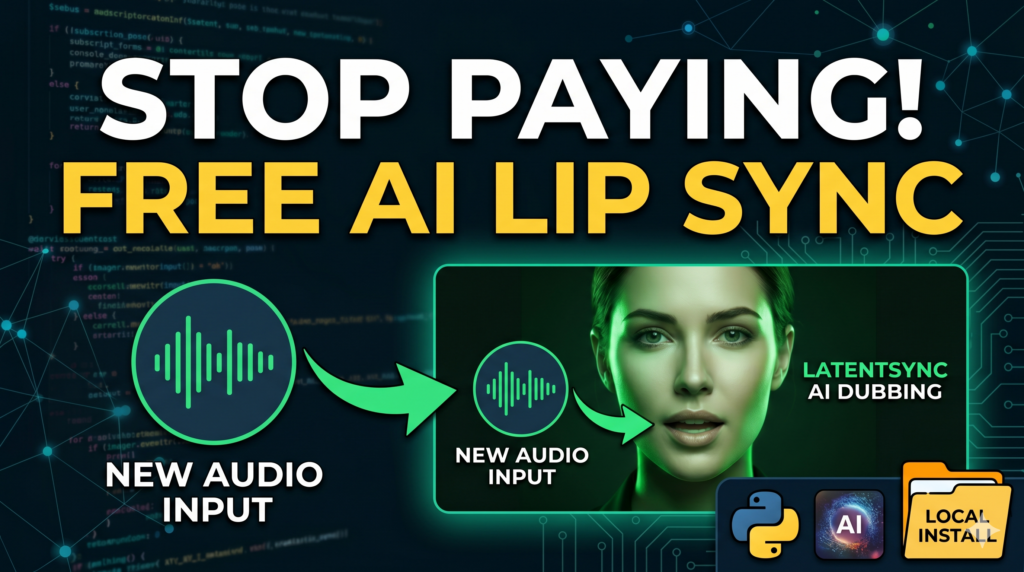
Stop paying exorbitant subscription fees and dealing with restrictive usage tiers for AI video dubbing services. This article provides a comprehensive, hands-on engineering walkthrough for configuring and running a cutting-edge, self-hosted alternative entirely on your own local workstation. By leveraging the advanced power of open-source artificial intelligence, you will learn how to take any video file and seamlessly align its lip movements to match a completely new audio track with remarkable precision.
By following this guide, you will unlock complete creative and technical independence from costly third-party cloud platforms. Instead of wasting money on pay-per-minute rendering models that drain your budget, this tutorial empowers you to build an unrestricted, production-ready environment using your existing local graphics hardware. For computer vision engineers, developers, and technical content creators, mastering this local workflow provides absolute data privacy, eliminates platform latency, and allows for endless experimentation without a financial penalty.
We achieve this by breaking down a production-grade codebase into an easy-to-follow, step-by-step implementation plan. This guide walks you through setting up a robust Linux environment on Windows using Windows Subsystem for Linux (WSL), isolating your system with a dedicated Python package manager, and deploying the model’s core architecture. You will see exactly how to manage system dependencies and pull the required deep learning weights so that you can launch an interactive, local web interface right from your terminal.
At the heart of this entire local workflow is a breakthrough framework known as LatentSync. Developed to solve complex audio-visual correlations, this tool operates as a specialized free open source lip sync ai that processes videos frame by frame. Rather than relying on traditional, pixel-space transformations that often look warped or artificial, this technology operates inside a compressed latent space to achieve professional-grade anatomical realism and fluid facial movements.
Discovering the power of free open source lip sync ai The shift toward a completely local, free open source lip sync ai represents a massive leap forward for open-science generative media. Historically, high-fidelity talking-head generation required closed-source APIs and massive cloud computing clusters. Modern frameworks have changed the landscape by utilizing advanced Audio-Conditioned Latent Diffusion Models (LDMs) alongside Stable Diffusion architectures. This combination allows a standard consumer GPU to analyze acoustic features from an input audio file and translate them into highly accurate spatial movements of the mouth, jaw, and lower face.
The primary objective of this technology is to bridge the gap between human speech and visual realism without introducing distracting digital artifacts. When a new audio file is fed into the system, a lightweight neural network extracts temporal speech characteristics frame by frame. These audio features act as a continuous guide or “condition” for the diffusion process, instructing the model exactly how the lips should form around specific syllables, vowels, and consonants, while keeping the rest of the facial expressions entirely intact.
Operating this framework locally gives you an uncompromised level of control over the underlying architecture. By utilizing specialized text-to-speech or vocal audio inputs, you can easily repurpose a single video clip into dozens of different localized languages or modified scripts. Because the entire pipeline runs locally on your terminal via standard Python scripts, you bypass corporate API restrictions, eliminate recurring monthly overhead, and gain a foundational understanding of how modern latent diffusion models handle real-world video processing.
Comparing LatentSync with other open-source alternatives When choosing an open-source framework for digital human generation and video dubbing, understanding the underlying architectural trade-offs is crucial for optimizing your rendering pipeline.
To help you choose the best framework for your deployment requirements, the matrix below compares LatentSync against Wav2Lip (the traditional Generative Adversarial Network baseline) and MuseTalk (Tencent’s real-time latent space inpainting model). While Wav2Lip remains incredibly fast and accessible for lower-end hardware, its pixel-space boundaries often introduce visible blurring around the lower jaw. On the other hand, newer frameworks like LatentSync and MuseTalk perform their processing directly inside compressed latent spaces, preserving high-frequency facial details and texture consistency even during extreme head rotations.
Feature / Metric LatentSync MuseTalk Wav2Lip Core Architecture Latent Diffusion Model (LDM) Latent Space Inpainting GAN (Generative Adversarial) Processing Domain Latent Space (Stable Diffusion) Latent Space (VAE ft-mse) Pixel Space Performance Speed Iterative / Non-Real-Time Real-time (30 FPS+ on V100) Fast / Near Real-Time Input Requirements Existing Video + Audio Video/Image + Audio Existing Video + Audio Target Resolution High (Sharp facial boundaries) Moderate (256×256 face region) Low (96×96 mouth bounding box) Licensing Non-Commercial / Research MIT License (Commercial Allowed) Non-Commercial
How to Run Free Open Source Lip Sync AI 10 Getting your local machine ready to run LatentSync The initialization script is the foundational blueprint that configures your hardware to process intensive latent diffusion computations without relying on external cloud APIs. The primary objective of this code sequence is to establish an isolated, highly reproducible execution environment on a Windows machine by bridging over to a native Linux ecosystem. By isolating software dependencies and compiling system-level libraries directly within a localized subsystem, the code ensures that your primary operating system remains clean while providing the deep learning model with the exact low-level environment it needs to communicate with your graphics hardware.
At its core, this technical configuration manages the transition from standard system execution to a dedicated artificial intelligence pipeline. It orchestrates everything from repository synchronization and virtual environment creation to down-stream asset management. By standardizing package versions and resolving complex media processing paths upfront, the script eliminates the common “dependency hell” often associated with open-source audio and video synthesis frameworks.
The target of this specific script is to fully automate the provisioning of your runtime space, ensuring that the critical neural weights can load seamlessly into memory. The installation pipeline intentionally explicitly configures media format parsers alongside deep learning frameworks so that raw audio waveforms and pixel arrays can be translated into matching multi-dimensional matrices. This preparation is what eventually allows the localized web interface to spin up and successfully route your custom inputs through the generative backend.
Ultimately, executing this sequence converts a standard terminal into a powerful, self-contained media rendering node. By establishing a robust system layer, configuring environment variables, and pulling exact model checkpoints from public repositories, the code removes the friction of complex machine learning deployments. Once these command-line steps finish running, your system is fully optimized to translate incoming acoustic signals into anatomically precise, frame-by-frame facial movements.
Why do we need to use a Linux subsystem instead of running the code directly on native Windows? While it is technically possible to run certain Python scripts directly on Windows, deep learning frameworks like LatentSync rely heavily on native Linux binaries, specialized C++ extensions, and complex media dependencies like FFmpeg that compile much more reliably in a Unix-like environment. Utilizing Windows Subsystem for Linux (WSL) allows developers to maintain their preferred desktop operating system while simultaneously granting the AI models direct, high-performance access to the underlying NVIDIA graphics card through shared CUDA drivers. This ensures maximum inference speed, eliminates cross-platform library conflicts, and mirrors the exact production environments where these advanced diffusion models are engineered and tested.
Link to the tutorial here
Download the code / instruction files for the tutorial here or here
Link for Medium users here
Master Computer Vision
Follow my latest tutorials and AI insights on my
Personal Blog .
Beginner Complete CV Bootcamp
Foundation using PyTorch & TensorFlow.
Get Started → Interactive Deep Learning with PyTorch
Hands-on practice in an interactive environment.
Start Learning → Advanced Modern CV: GPT & OpenCV4
Vision GPT and production-ready models.
Go Advanced →
How to Run Free Open Source Lip Sync AI 11 Stop paying exorbitant subscription fees and dealing with restrictive usage tiers for AI video dubbing services. This article provides a comprehensive, hands-on engineering walkthrough for configuring and running a cutting-edge, self-hosted alternative entirely on your own local workstation. By leveraging the advanced power of open-source artificial intelligence, you will learn how to take any video file and seamlessly align its lip movements to match a completely new audio track with remarkable precision.
By following this guide, you will unlock complete creative and technical independence from costly third-party cloud platforms. Instead of wasting money on pay-per-minute rendering models that drain your budget, this tutorial empowers you to build an unrestricted, production-ready environment using your existing local graphics hardware. For computer vision engineers, developers, and technical content creators, mastering this local workflow provides absolute data privacy, eliminates platform latency, and allows for endless experimentation without a financial penalty.
We achieve this by breaking down a production-grade codebase into an easy-to-follow, step-by-step implementation plan. This guide walks you through setting up a robust Linux environment on Windows using Windows Subsystem for Linux (WSL), isolating your system with a dedicated Python package manager, and deploying the model’s core architecture. You will see exactly how to manage system dependencies and pull the required deep learning weights so that you can launch an interactive, local web interface right from your terminal.
At the heart of this entire local workflow is a breakthrough framework known as LatentSync. Developed to solve complex audio-visual correlations, this tool operates as a specialized free open source lip sync ai that processes videos frame by frame. Rather than relying on traditional, pixel-space transformations that often look warped or artificial, this technology operates inside a compressed latent space to achieve professional-grade anatomical realism and fluid facial movements.
Discovering the power of free open source lip sync ai The shift toward a completely local, free open source lip sync ai represents a massive leap forward for open-science generative media. Historically, high-fidelity talking-head generation required closed-source APIs and massive cloud computing clusters. Modern frameworks have changed the landscape by utilizing advanced Audio-Conditioned Latent Diffusion Models (LDMs) alongside Stable Diffusion architectures. This combination allows a standard consumer GPU to analyze acoustic features from an input audio file and translate them into highly accurate spatial movements of the mouth, jaw, and lower face.
The primary objective of this technology is to bridge the gap between human speech and visual realism without introducing distracting digital artifacts. When a new audio file is fed into the system, a lightweight neural network extracts temporal speech characteristics frame by frame. These audio features act as a continuous guide or “condition” for the diffusion process, instructing the model exactly how the lips should form around specific syllables, vowels, and consonants, while keeping the rest of the facial expressions entirely intact.
Operating this framework locally gives you an uncompromised level of control over the underlying architecture. By utilizing specialized text-to-speech or vocal audio inputs, you can easily repurpose a single video clip into dozens of different localized languages or modified scripts. Because the entire pipeline runs locally on your terminal via standard Python scripts, you bypass corporate API restrictions, eliminate recurring monthly overhead, and gain a foundational understanding of how modern latent diffusion models handle real-world video processing.
Getting your local machine ready to run LatentSync The initialization script is the foundational blueprint that configures your hardware to process intensive latent diffusion computations without relying on external cloud APIs. The primary objective of this code sequence is to establish an isolated, highly reproducible execution environment on a Windows machine by bridging over to a native Linux ecosystem. By isolating software dependencies and compiling system-level libraries directly within a localized subsystem, the code ensures that your primary operating system remains clean while providing the deep learning model with the exact low-level environment it needs to communicate with your graphics hardware.
At its core, this technical configuration manages the transition from standard system execution to a dedicated artificial intelligence pipeline. It orchestrates everything from repository synchronization and virtual environment creation to down-stream asset management. By standardizing package versions and resolving complex media processing paths upfront, the script eliminates the common “dependency hell” often associated with open-source audio and video synthesis frameworks.
The target of this specific script is to fully automate the provisioning of your runtime space, ensuring that the critical neural weights can load seamlessly into memory. The installation pipeline intentionally explicitly configures media format parsers alongside deep learning frameworks so that raw audio waveforms and pixel arrays can be translated into matching multi-dimensional matrices. This preparation is what eventually allows the localized web interface to spin up and successfully route your custom inputs through the generative backend.
Ultimately, executing this sequence converts a standard terminal into a powerful, self-contained media rendering node. By establishing a robust system layer, configuring environment variables, and pulling exact model checkpoints from public repositories, the code removes the friction of complex machine learning deployments. Once these command-line steps finish running, your system is fully optimized to translate incoming acoustic signals into anatomically precise, frame-by-frame facial movements.
Why do we need to use a Linux subsystem instead of running the code directly on native Windows? While it is technically possible to run certain Python scripts directly on Windows, deep learning frameworks like LatentSync rely heavily on native Linux binaries, specialized C++ extensions, and complex media dependencies like FFmpeg that compile much more reliably in a Unix-like environment. Utilizing Windows Subsystem for Linux (WSL) allows developers to maintain their preferred desktop operating system while simultaneously granting the AI models direct, high-performance access to the underlying NVIDIA graphics card through shared CUDA drivers. This ensures maximum inference speed, eliminates cross-platform library conflicts, and mirrors the exact production environments where these advanced diffusion models are engineered and tested.
Setting up your environment and isolation layer Deploying a local, open-source AI video solution requires a structured and clean pipeline to avoid dependency conflicts across software versions. This first stage focuses entirely on building the foundational execution sandbox on your local machine using terminal virtualization and repository cloning. By properly separating your environmental packages, you guarantee that the deep learning frameworks have unhindered access to low-level hardware drivers.
Executing this block transitions your workspace from a generic operating terminal into a dedicated machine learning development station. The commands handle the structural framework pull, initialize a pinned virtual environment, and establish system-level hooks for graphic processing and video compilation libraries. Once completed, your workstation will possess a clean, isolated platform specifically optimized to ingest neural layers and manage multi-media components.
This stage wraps up the complete preparation of the baseline operating boundaries, meaning your environment is fully fortified and ready to absorb the heavier deep learning assets. By isolating Python versions and injecting system dependencies early, you eliminate runtime crashes during live matrix multiplications later in the process. The script below is a self-contained environment initialization sequence designed to prepare your workstation for the core generative processing task.
How does Conda ensure system isolation when compiling custom deep learning frameworks? Conda operates by creating independent, self-contained directory trees for each environment, entirely isolating binaries, libraries, and your target Python path from the global operating system. This separation ensures that updates to system-wide tools do not overwrite or corrupt the precise package configurations required by complex generative pipelines like LatentSync.
### Initialize the Windows Subsystem for Linux environment wsl ### Navigate to your working directories folder cd tutorials ### Clone the official open-source repository from GitHub git clone https : // github . com / bytedance / LatentSync . git ### Move directly into the root directory of the cloned project cd LatentSync ### Create an isolated virtual conda ecosystem using Python version 3.10 conda create - y - n latentsync python = 3.10 ### Activate the newly generated virtual environment boundary conda activate latentsync ### Install the essential FFmpeg multimedia processing binary from the forge channel conda install - y - c conda - forge ffmpeg ### Download and link all specific Python application dependencies pip install - r requirements . txt ### Deploy the core system OpenGL graphics support library for image processing sudo apt - y install libgl1 This sequence fully prepares your infrastructure, ensures software isolation, and installs the required runtime dependencies directly inside your local Linux terminal shell.
Downloading checkpoints and starting the browser interface With the foundation established, the focus transitions directly into downloading deep learning assets and mounting the graphical entry point. This terminal phase handles the secure communication with remote artifact repositories to fetch pre-trained weights compiled by research teams. These structural parameters allow the model to interpret acoustic signals and reconstruct facial structures frame-by-frame on local hardware.
The code calls downstream file managers to orchestrate model layouts, parsing specific structural files into local checkpoint paths. Once the structural directories mirror the expected blueprint, the command line executes a Python initialization script to launch a local browser server. This graphical user interface acts as the frontend controller, giving you visual sliders and file selectors to drop in your multi-media recordings.
Running this script completely closes out the local build phase and transfers full system execution into an interactive web portal. The terminal remains open as an active background monitoring logger, tracking frame output generation speeds as you sync video tracks. The final sequence below completes your local deployment loop, shifting your terminal configuration into an operational generative media application.
Why do we fetch separate model parameters for both LatentSync and Whisper? LatentSync requires dual-stream asset inputs: a Whisper module to extract temporal acoustic speech matrices from your sound file, and a specialized UNet architecture to process latent diffusion video arrays. Separating these files ensures each transformer layer handles its designated domain—audio transcription and visual reconstruction—before blending them frame by frame.
### Download the foundational whisper audio tracking parameters into local storage huggingface - cli download ByteDance / LatentSync - 1.6 whisper / tiny . pt -- local - dir checkpoints ### Fetch the core audio conditioned latent diffusion unet model weights huggingface - cli download ByteDance / LatentSync - 1.6 latentsync_unet . pt -- local - dir checkpoints This final code block downloads the deep learning checkpoints into their designated directory structures.
Launching and navigating the interactive web interface The final step in your local deployment pipeline transitions you out of the command-line interface and into an accessible browser-based production dashboard. Executing the runtime script initializes a localized Gradio web server, which acts as the frontend graphical controller bridging your raw input assets with the underlying deep learning engine. This local framework eliminates the need to run complex arguments or manual file paths inside your shell, replacing them with interactive sliders, parameter toggles, and instant video drag-and-drop landing fields.
When you run the command, your terminal launches a background worker pool that mounts an active listener on a local port, typically mapping directly to http://127.0.0.1:7860. From this interface, you can upload your base target video clip alongside your new, matching voice track. The backend pipeline is structured to automatically isolate the active facial regions from the video frames, extract the acoustic sequences via the Whisper module, and run the latent diffusion iterations seamlessly entirely within your local GPU’s memory bounds.
Monitoring the backend processing outputs directly inside your terminal window provides excellent debugging information and visibility into your hardware performance. As the web application processes your files, the command line prints real-time status updates, detailing tracking matrices, rendering progress percentages, and structural compilation logs. Once the generation loop finishes, your newly synchronized video is served directly in the web player interface, fully completed and ready for immediate download.
How does the Gradio framework interact with deep learning scripts in real-time? Gradio serves as a lightweight, reactive Python wrapper that wraps around your core machine learning functions, converting standard inputs like video and audio files into standardized arrays that the PyTorch backend can process. When you hit the submit button in your browser, the dashboard triggers a localized API call that passes the file paths directly into the LatentSync diffusion sequence, captures the processed output file upon completion, and dynamically renders it back on your webpage without requiring a manual server refresh.
### Initialize the web based user interface application via the gradio engine python gradio_app . py This command mounts the active visualization environment on your system, allowing you to easily handle complex latent transformations through an intuitive, localized interface.
How to Run Free Open Source Lip Sync AI 12 Frequently Asked Questions What hardware is required to run this free open source lip sync ai locally? + You will need an NVIDIA GPU with at least 6GB to 8GB of VRAM to handle the model weights comfortably inside WSL. Running on CPU is technically possible but will result in extremely slow rendering times per frame.
Why does the script require Python 3.10 specifically inside Conda? + Deep learning packages like PyTorch and specific CUDA extensions in LatentSync are strictly compiled for Python 3.10 bindings. Deviating to newer versions can break dependency links during setup.
How do I fix "command not found: conda" when running inside WSL? + This happens if Miniconda or Anaconda isn’t fully initialized inside your Linux distribution. Run `conda init bash`, restart your terminal shell, and retry activating your environment path.
Can I use this system to sync long-form video files completely? + Yes, but long clips require substantial processing memory and rendering times. It is highly recommended to split your recordings into shorter 15-30 second segments for optimal VRAM management.
What should I do if I encounter a "LibGL.so.1 error" during launch? + This is a common headless Linux issue where OpenCV cannot find core graphics rendering modules. Running the `sudo apt install libgl1` command solves this dependency gap instantly.
Is my data private when running this architecture on a local terminal? + Absolutely. Because the entire framework runs locally via WSL, no video clips or audio samples are ever transmitted to external servers or cloud networks.
How does this framework handle multiple faces in a single video frame? + The current open-source model targets the primary, most prominent face identified by bounding box coordinates. For multi-speaker tracking, pre-cropping your video clip is advised.
Why is the audio quality or matching slightly off on my output file? + Ensure your audio sample is clean, clear, and matches the language of the script. Background noise or music tracks can confuse the Whisper acoustic processing engine.
Can I commercialize the output videos generated by LatentSync? + The pre-trained weights are generally released under a research-oriented, non-commercial license. Always review the official ByteDance repository license details before business distribution.
How does a latent diffusion model compare to traditional pixel systems? + Latent models compute complex changes inside a compressed mathematical space rather than editing raw pixel grids directly. This maintains sharp facial expressions and texture details without introducing blur.
Conclusion Deploying a local instance of LatentSync represents a definitive step toward engineering self-sufficiency and away from restrictive, subscription-bound third-party APIs. By setting up Windows Subsystem for Linux (WSL), isolating dependencies using Conda virtual workspaces, and operating entirely inside a compressed latent space via Audio-Conditioned Latent Diffusion Models, you have built an optimized production engine tailored for professional-grade facial rendering. Running tasks on local hardware safeguards your workflows, optimizes system metrics, and guarantees absolute control over every phase of video generation.
As open-science generative visual technology advances, hosting these networks locally gives you a foundational edge in handling modern multi-media data pipelines. By eliminating continuous billing overhead, you gain the freedom to test, scale, and integrate custom python automation paths without transactional friction. Continue building your local ecosystem, maintain clean terminal dependencies, and explore the vast potential of open-source computer vision execution right from your own desktop interface.
Connect ☕ Buy me a coffee — https://ko-fi.com/eranfeit
🖥️ feitgemel@gmail.com
🌐 https://eranfeit.net
🤝 Fiverr : https://www.fiverr.com/s/mB3Pbb
Enjoy,
Eran
 Skip to content