...

Pytorch

Create Synthetic Data for Computer Vision Pipelines

Synthetic Data for Computer Vision

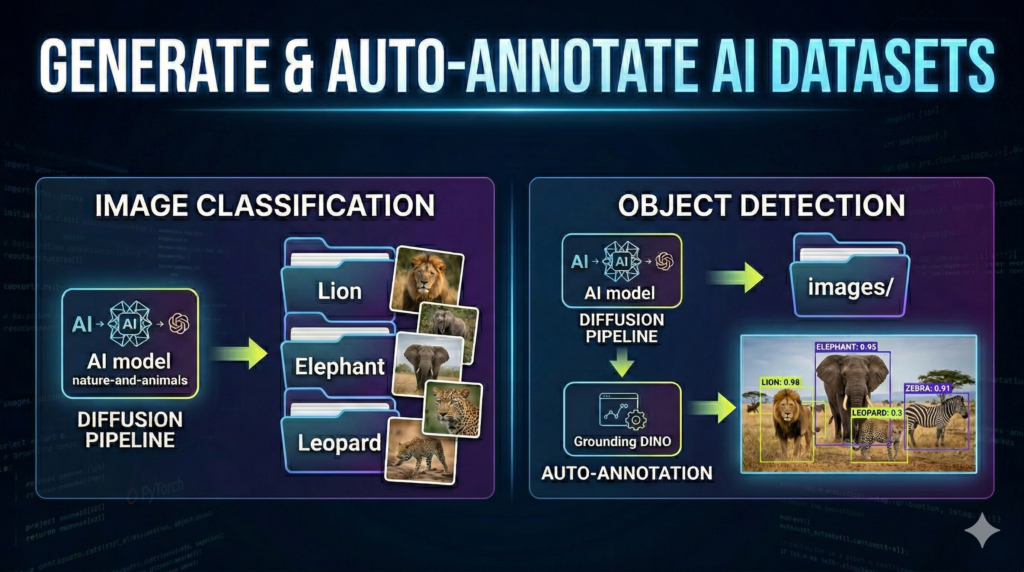
The process of manual data annotation has long been the most significant bottleneck in developing high-performance machine learning models. This tutorial focuses on a revolutionary shift in the industry: leveraging Synthetic Data for Computer Vision to bypass the tedious weeks spent in labeling software. By combining the generative power of Stable Diffusion with the intelligent […]

Create Synthetic Data for Computer Vision Pipelines Read More »

How to Train ConvNeXt in PyTorch on a Custom Dataset

ConvNext

ConvNeXt has become one of the most practical “modern CNN” choices when you want strong accuracy without giving up the speed and simplicity that make convolutional networks so useful in real projects. This article is about training ConvNeXt in PyTorch on a custom dataset—the kind you actually have in day-to-day work: folders of images organized

How to Train ConvNeXt in PyTorch on a Custom Dataset Read More »

Generate synthetic images for image classification in Python

generate synthetic images for image classification

This article explains how to generate synthetic images for image classification using Python, Hugging Face Diffusers, and Stable Diffusion. It focuses on building a practical workflow that turns text prompts into high-quality training images, helping developers and researchers create datasets without scraping the web or manually collecting photos. By following a reproducible pipeline, you can

Generate synthetic images for image classification in Python Read More »

Brain Tumor Segmentation with YOLOv11 in Python

Brain Tumor Segmentation

Brain Tumor Segmentation with YOLOv11 in Python: What You’ll Build This article walks through a complete, practical workflow for brain tumor segmentation using YOLOv11 and Python, from environment setup and training to inference and mask export.Instead of stopping at “the model predicts something,” you’ll go all the way to saving individual segmentation masks, combining them

Brain Tumor Segmentation with YOLOv11 in Python Read More »

I tried the Ultralytics SAM2 tutorial with YOLO11. Here’s what happened.

ultralytics sam2 tutorial

Ultralytics SAM2 Tutorial, Explained Like You’d Code It An ultralytics sam2 tutorial is really about one idea: using a strong detector to tell SAM2 “where to look,” then letting SAM2 handle the hard part—drawing object boundaries.In this pipeline, YOLO11 produces bounding boxes for each image, and those boxes become box prompts for SAM2.1.This is a

I tried the Ultralytics SAM2 tutorial with YOLO11. Here’s what happened. Read More »

Here’s What Combining YOLOv11 with SAM2 Taught Me About Segmentation

teeth segmentation

Building a practical teeth segmentation pipeline with YOLOv11 + SAM2 This article is about automating teeth segmentation so you can generate accurate masks without hand-drawing pixel labels for every dental image.That matters because segmentation projects often fail at the dataset stage, where annotation time and inconsistency become the biggest bottlenecks. The article walks through a

Here’s What Combining YOLOv11 with SAM2 Taught Me About Segmentation Read More »

Complete Guide to SAM2 Video Segmentation in Python

Segment Anything in videos

SAM2 video segmentation is a practical way to turn a single user interaction into consistent object masks across an entire video.Instead of segmenting every frame manually, you mark the object once using a few point clicks, and the model carries that object forward through time.This makes video segmentation feel much closer to an interactive editing

Complete Guide to SAM2 Video Segmentation in Python Read More »

Interactive SAM2 Segmentation: Points, Boxes, and Masks

SAM2 tutorial

SAM2 Tutorial is quickly becoming one of the most practical ways for Python developers to get high-quality segmentation without training a model from scratch.Instead of building a dataset, tuning a network, and waiting for epochs to finish, you can load a pretrained SAM2 checkpoint and start extracting pixel-accurate masks right away.This is especially useful when

Interactive SAM2 Segmentation: Points, Boxes, and Masks Read More »

How to Train Mask R‑CNN on Lung Segmentation Data

Lung segmentation

Introduction Lung segmentation is one of the most important tasks in medical image analysis, especially when working with chest X-rays and CT scans.By accurately isolating lung regions from the rest of the image, it becomes much easier to analyze structure, detect abnormalities, and build reliable downstream models for diagnosis and monitoring.In recent years, deep learning

How to Train Mask R‑CNN on Lung Segmentation Data Read More »

Eran Feit