 Skip to content
Last Updated on 23/12/2025 by Eran Feit
Introduction
BLIP-2 image analysis Python is becoming one of the most practical ways to connect visual data with natural language understanding.
Instead of treating images and text as separate worlds, BLIP-2 brings them together in a single multimodal model that can both describe what it sees and answer questions about images.
With BLIP-2 image analysis Python, developers can load an image, understand its content, and interact with it using plain English.
This approach removes the need for manual annotations or task-specific vision models, making image understanding far more flexible and accessible.
The power of BLIP-2 lies in its ability to combine a frozen vision encoder with a large language model.
This design allows the model to reason about images in a conversational way while keeping computational costs manageable.
For Python developers working with computer vision, BLIP-2 image analysis Python opens the door to use cases like visual question answering, image captioning, and AI-driven image exploration using a single unified workflow.
BLIP-2 image analysis Python explained in a practical way
BLIP-2 image analysis Python focuses on teaching machines how to interpret images through language.
Instead of producing only labels or bounding boxes, BLIP-2 generates meaningful text that reflects what the model understands from the image.
At a high level, BLIP-2 processes an image through a vision encoder and then connects that visual information to a language model.
This allows the system to generate descriptions, answer questions, and reason about visual scenes in a way that feels natural and intuitive.
The target use case for BLIP-2 image analysis Python is interaction rather than classification.
You are not just asking what objects exist in an image, but also asking questions like colors, quantities, relationships, and contextual details.
This makes BLIP-2 especially useful for applications such as AI assistants, image-based chat systems, content moderation, accessibility tools, and visual search.
By combining Python, PyTorch, and Hugging Face Transformers, developers can experiment with advanced image reasoning using relatively compact and readable code.
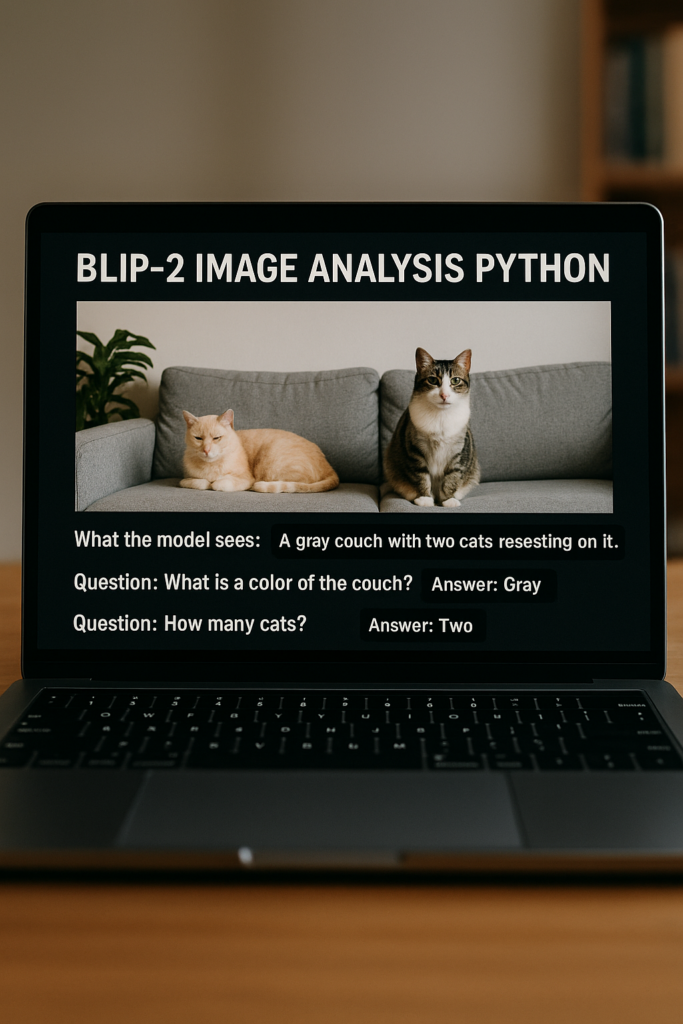
Understanding the BLIP-2 image analysis Python tutorial
This tutorial is designed to walk through BLIP-2 image analysis Python in a clear, hands-on way, focusing on how the code actually works and what each stage is meant to achieve.
Instead of abstract theory, the goal is to help you run real code that loads an image, processes it with BLIP-2, and produces meaningful language outputs.
The main target of the code is to demonstrate how a single multimodal model can both analyze an image and answer questions about it.
By using the same image as input and changing only the text prompt, the code shows how BLIP-2 can switch between describing a scene and responding to specific questions without retraining or task-specific logic.
At a high level, the tutorial guides you through three core steps: preparing the environment, loading the BLIP-2 model and processor, and running inference on an image.
Each of these steps is essential for understanding how vision-language models are used in practice with Python, PyTorch, and the Transformers library.
The final outcome of the code is a working example of interactive image understanding.
You can see what the model “sees,” ask targeted questions such as colors or object counts, and receive natural language answers, all driven by the same BLIP-2 image analysis Python workflow.

Link to the video tutorial : https://youtu.be/_kuGdmEFiVs
Code for the tutorial here : https://eranfeit.lemonsqueezy.com/buy/12ff7424-471c-40d2-beeb-b3bf3b86f2d4 or here : https://ko-fi.com/s/1c80391bbe
Link to the post for Medium users : https://medium.com/@feitgemel/how-to-run-blip-2-image-analysis-with-python-7ff731707956
You can follow my blog here : https://eranfeit.net/blog/
Want to get started with Computer Vision or take your skills to the next level ?
If you’re just beginning, I recommend this step-by-step course designed to introduce you to the foundations of Computer Vision – Complete Computer Vision Bootcamp With PyTorch & TensorFlow
If you’re already experienced and looking for more advanced techniques, check out this deep-dive course – Modern Computer Vision GPT, PyTorch, Keras, OpenCV4
BLIP-2 image analysis Python tutorial
BLIP-2 image analysis Python allows you to combine computer vision and natural language understanding in a single workflow.
Instead of building separate models for captioning, classification, or question answering, BLIP-2 lets you interact with images using plain text prompts.
This tutorial focuses on practical usage rather than theory.
You will see how to install the environment, load the BLIP-2 model, analyze an image, and ask natural language questions about what the model sees.
The goal is to help you understand how multimodal vision-language models work in real Python code.
By the end, you will have a reusable template for image understanding, visual question answering, and AI-powered image interaction.
Setting up the environment for BLIP-2
This part prepares a clean Python environment that can run BLIP-2 efficiently on GPU or CPU.
Using Conda ensures reproducibility and avoids dependency conflicts.
The focus here is matching Python, CUDA, PyTorch, and Transformers versions correctly.
This is essential for stable inference with large multimodal models.
### Create a new Conda environment with Python 3.11. conda create -n BLIP-2 python=3.11 ### Activate the newly created environment. conda activate BLIP-2 ### Check the installed CUDA version to ensure GPU compatibility. nvcc --version ### Install PyTorch with CUDA support for accelerated inference. conda install pytorch==2.5.0 torchvision==0.20.0 torchaudio==2.5.0 pytorch-cuda=12.4 -c pytorch -c nvidia ### Install SymPy which is required by PyTorch internals. pip install sympy==1.13.1 ### Install Hugging Face Transformers for BLIP-2 support. pip install transformers==4.46.2 ### Upgrade Transformers directly from source if token length errors appear. pip install --upgrade git+https://github.com/huggingface/transformers.git This setup ensures your system is ready to run BLIP-2 image analysis Python code smoothly.
Loading the BLIP-2 model and processor
This section loads the pretrained BLIP-2 model and its processor.
The processor handles both image preprocessing and text tokenization.
The model itself combines a frozen vision encoder with a language model.
This allows the system to reason about images using natural language.
### Import the BLIP-2 model and processor from Transformers. from transformers import Blip2ForConditionalGeneration, Blip2Processor ### Import PyTorch for tensor operations and device handling. import torch ### Import image handling utilities. from PIL import Image import requests ### Select GPU if available, otherwise fall back to CPU. device = 'cuda' if torch.cuda.is_available() else 'cpu' ### Load the BLIP-2 processor from the pretrained checkpoint. processor = Blip2Processor.from_pretrained("Salesforce/blip2-opt-2.7b") ### Load the BLIP-2 model from the same pretrained checkpoint. model = Blip2ForConditionalGeneration.from_pretrained("Salesforce/blip2-opt-2.7b") ### Move the model to the selected device. model.to(device) At this stage, the BLIP-2 model is fully loaded and ready for inference.
Running image analysis to see what the model understands
Here the code feeds an image into BLIP-2 without a question.
This allows the model to generate a general description of what it sees.
This step is useful for understanding the baseline perception of the image.
It acts as an image captioning phase.
Test image :
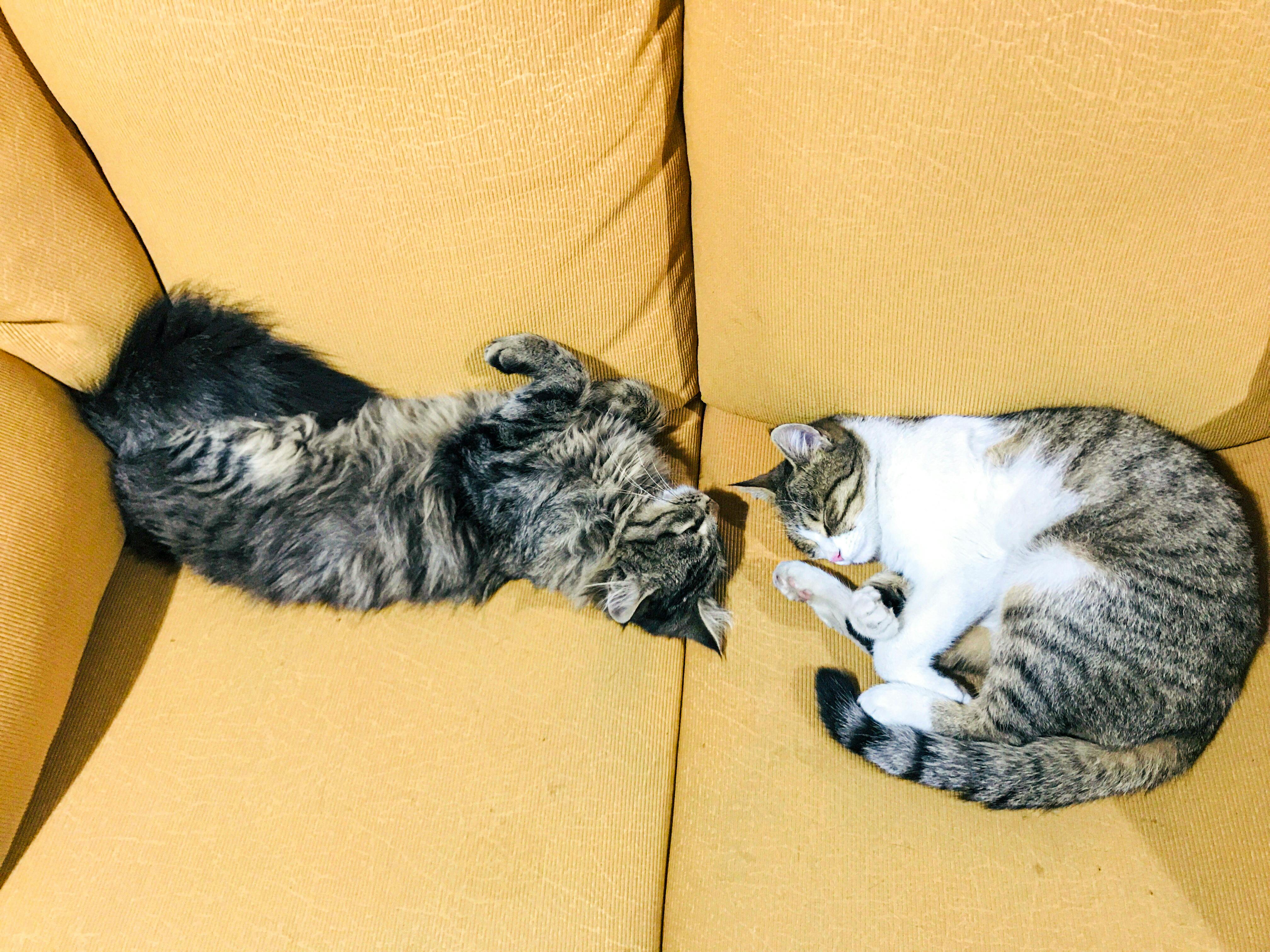
### Define the image URL to analyze. url = "https://images.pexels.com/photos/12426042/pexels-photo-12426042.jpeg" ### Load the image from the URL. image = Image.open(requests.get(url, stream=True).raw) ### Prepare inputs for the model without a text prompt. inputs = processor(images=image, return_tensors='pt', text="") ### Move inputs to the same device as the model. inputs.to(device) ### Generate text output from the image. generate_ids = model.generate(**inputs, max_new_tokens=50) ### Decode the generated token IDs into readable text. generated_text = processor.batch_decode(generate_ids, skip_special_tokens=True)[0].strip() ### Print the model’s description of the image. print("**********************************************") print("What the model sees: " + generated_text) print("**********************************************") This output gives a clear overview of the image content from the model’s perspective.
Asking questions about the image using natural language
This final part demonstrates visual question answering.
By changing only the text prompt, the same image can answer multiple questions.
This shows the real strength of BLIP-2 image analysis Python.
The model behaves like a conversational interface for visual data.
### Ask a question about the image using a natural language prompt. prompt = "Question: What is the color of the couch? Answer:" ### Prepare inputs with both image and question. inputs = processor(images=image, return_tensors='pt', text=prompt) ### Move inputs to the model device. inputs.to(device) ### Generate an answer from the model. generate_ids = model.generate(**inputs, max_new_tokens=50) ### Decode the answer into readable text. generated_text = processor.batch_decode(generate_ids, skip_special_tokens=True)[0].strip() ### Print the answer. print("**********************************************") print("What is the color of the couch?: " + generated_text) print("**********************************************") ### Ask another question about object count. prompt = "Question: How many cats? Answer:" ### Prepare new inputs with the updated question. inputs = processor(images=image, return_tensors='pt', text=prompt) ### Move inputs to the model device. inputs.to(device) ### Generate the response. generate_ids = model.generate(**inputs, max_new_tokens=50) ### Decode and print the result. generated_text = processor.batch_decode(generate_ids, skip_special_tokens=True)[0].strip() print("**********************************************") print("How many cats?: " + generated_text) print("**********************************************") ### Display the image locally. image.show() This approach enables interactive and flexible image understanding using Python.
FAQ
What is BLIP-2 image analysis Python?
It is a Python-based approach for understanding images using natural language prompts.
Can BLIP-2 answer questions about images?
Yes. BLIP-2 supports visual question answering using text prompts.
Does BLIP-2 work on CPU?
Yes, but GPU is recommended for faster inference.
Conclusion
BLIP-2 image analysis Python demonstrates how modern AI models can understand images through language rather than fixed labels.
By combining vision encoders and language models, BLIP-2 enables flexible image reasoning, captioning, and question answering.
This tutorial showed how to set up the environment, load the model, analyze an image, and interact with it using natural language.
The same structure can be reused for many real-world applications such as AI assistants, accessibility tools, and visual search systems.
As vision-language models continue to evolve, BLIP-2 provides a practical and approachable way to explore multimodal AI using Python.
Connect
☕ Buy me a coffee — https://ko-fi.com/eranfeit
🖥️ Email : feitgemel@gmail.com
🤝 Fiverr : https://www.fiverr.com/s/mB3Pbb
Enjoy,
Eran