 Skip to content
Last Updated on 18/02/2026 by Eran Feit
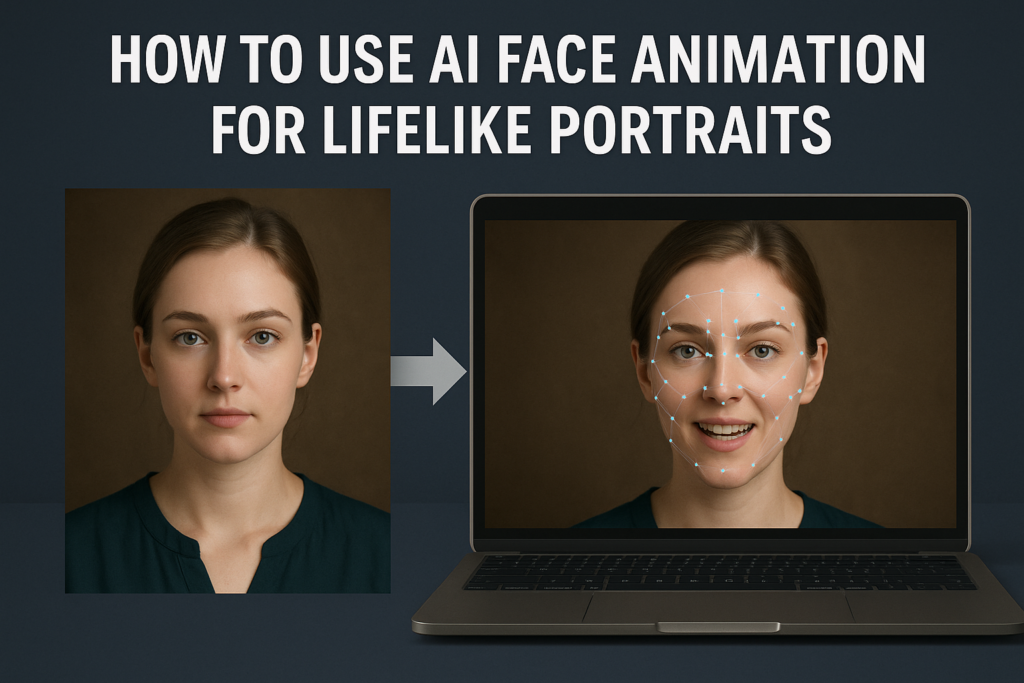
AI face animation is an advanced technique that breathes life into still portraits by applying artificial intelligence to understand and reproduce facial expressions and movements. It begins with facial feature detection—mapping key points such as eyes, nose, mouth and jaw. The system then analyses the subject’s expressions and applies predefined or custom animation templates to generate realistic movement. The result is a video or GIF where a once-static face appears to blink, smile, and speak, creating a vivid, engaging representation.
At the heart of this technology are motion‑capture data and deep neural networks that transfer movement from one face to another. Researchers have shown that a deep learning system can transfer a person’s full 3D head position, facial expression and eye gaze from one video to another. This means a source actor’s head pose and expressions can control a target portrait, enabling the portrait to mimic another person’s movements rather than inventing new facial features
AI face animation serves many creative and practical purposes. On social media, it turns profile photos into dynamic animations or GIFs. Families can animate cherished photographs for lively digital albums, while educators animate historical figures to create interactive lessons. Gamers and artists use AI face animation to build expressive avatars or generate AI art, exploring new ways to express personality and creativity in digital media.
Beyond personal use, AI face animation powers avatars and virtual beings in professional contexts. Real‑time avatar facial animation replicates a person’s expressions and emotions using 3D models, allowing lifelike interactions in virtual reality, video conferencing, gaming and customer service. Machine learning models track over 200 facial landmarks and capture millions of data points across a facei, enabling digital avatars to mirror the subtleties of a real person’s smile, frown or gaze with remarkable fidelity.
How AI Face Animation Works to Mimic Real Faces
To animate a portrait, you start with two pieces of media: a still image (the source) and a driving video that contains the movements you want to transfer. AI face animation analyses both pieces, detecting facial landmarks and extracting the head pose and expressions from the video. It then synthesizes new frames where the portrait’s face mimics those movements, producing a video in which the portrait appears to come alive.
The generative network behind this process uses deep learning to transfer 3D head pose, facial expressions and eye gaze from the driving video to the source image. After mapping the face, it employs pre‑trained models to generate realistic frames while maintaining the identity of the original subject. This approach differs from face generation; it re‑enacts the face with someone else’s motion rather than creating new features.
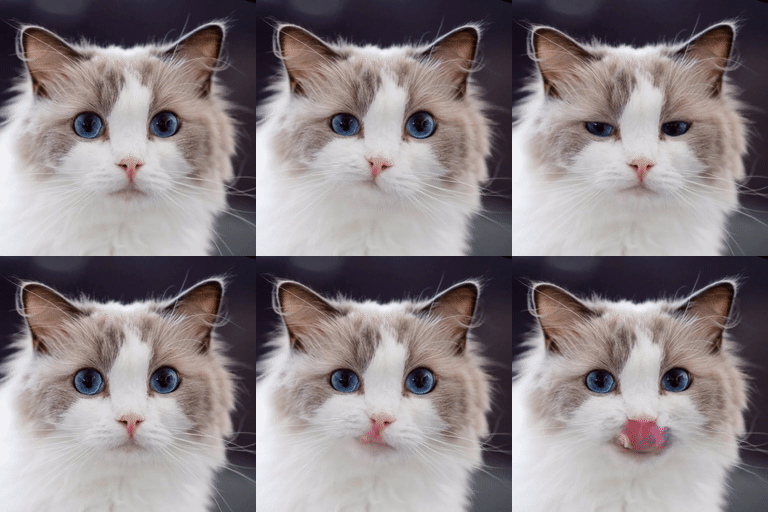
Users can fine‑tune the animation’s intensity and framing by adjusting parameters such as a “driving multiplier” or enabling automatic cropping. Advanced implementations even support animals—by building the necessary dependencies and models, the same workflow can make a pet’s portrait mimic motions from another clip. Developers can also input pre‑recorded motion trajectories (for example, in .pkl format) as the driving source.
AI face animation is accessible to a broad audience. Content creators and social media enthusiasts can produce lifelike animations for storytelling or entertainment, while educators and game developers can incorporate animated avatars into immersive experiences. For researchers and developers, open‑source tools allow experimentation with different models, weights and configurations to refine the realism of facial reenactment. As with any powerful technology, ethical considerations are paramount—responsible use ensures that this creative tool enhances communication and art without misrepresentation or misuse.
Understanding the Code Behind AI Face Animation in Practice
This tutorial focuses on a practical, hands-on implementation of AI face animation, showing how code can be used to animate a single portrait by transferring facial motion from another video. Instead of generating a new face, the code is designed to preserve the identity of the original portrait while realistically mimicking expressions, head movement, and mouth motion from a driving source. This approach is especially useful for creating lifelike results that feel natural and consistent.
At a high level, the target of the code is to solve a common challenge in portrait animation: how to make a static image move convincingly without rebuilding the face from scratch. The workflow takes two inputs—a source image and a driving video—and uses pretrained deep learning models to extract facial dynamics from the video. These dynamics are then applied to the source image, frame by frame, producing an animated portrait that follows the motion of the driving face.
The code is structured to guide users step by step through environment setup, model installation, weight downloading, and inference execution. Each stage reflects a real-world production pipeline: preparing the runtime environment, loading neural network weights, and running inference with configurable parameters. By adjusting options such as cropping, motion intensity, or animation mode, users can control how strongly the portrait reacts to the driving video and adapt the output to different use cases.
From a learning perspective, this tutorial is not just about running commands—it demonstrates how modern AI face animation systems are assembled and used in practice. It exposes the logic behind motion transfer, shows how pretrained models are integrated into an end-to-end workflow, and highlights how facial mimicry can be achieved programmatically. The result is a clear, code-focused path for anyone who wants to understand and experiment with AI-driven portrait animation in a reproducible and realistic way.
AI Image to Video & Live Portrait Animation


Link for the video tutorial : https://youtu.be/Pw4ZY0aMN0I
You can find the instructions and the demo files here : https://eranfeit.lemonsqueezy.com/buy/e9d37747-6ad0-46a6-b2b4-923c9eed936f or here : https://ko-fi.com/s/f790416f3b
Link to the post for Medium users : https://medium.com/cool-python-pojects/how-to-use-ai-face-animation-for-lifelike-portraits-2ed2e6d28a69
You can follow my blog here : https://eranfeit.net/blog/
Want to get started with Computer Vision or take your skills to the next level ?
If you’re just beginning, I recommend this step-by-step course designed to introduce you to the foundations of Computer Vision – Complete Computer Vision Bootcamp With PyTorch & TensorFlow
If you’re already experienced and looking for more advanced techniques, check out this deep-dive course – Modern Computer Vision GPT, PyTorch, Keras, OpenCV4
How to Use AI Face Animation for Lifelike Portraits
AI face animation makes it possible to bring a static portrait to life by transferring facial motion from a real video.
Instead of generating a new face, this approach preserves the identity of the original image and focuses on realistic motion such as head movement, eye direction, and mouth expressions.
In this tutorial, we walk through a complete, code-driven workflow based on a production-ready open-source implementation.
You will learn how to set up the environment, install dependencies, download pretrained weights, and run inference to animate portraits using a driving video.
The focus here is practical usage.
Every command is explained, every step has a clear purpose, and the result is a repeatable pipeline you can adapt for real projects, demos, or experiments.
Preparing the Environment for AI Face Animation
Before animating a portrait, the environment must be configured correctly.
This includes cloning the repository, creating an isolated Python environment, and ensuring CUDA compatibility.
Using a dedicated conda environment avoids version conflicts and ensures reproducibility.
The repository contains native extensions and GPU-accelerated code, so matching the CUDA version with PyTorch is essential for performance and stability.
Below is the setup phase that prepares the system for running AI face animation.
### Clone the repository to your local machine. git clone https://github.com/KwaiVGI/LivePortrait.git cd LivePortrait ### Create a dedicated conda environment with a compatible Python version. conda create -n LivePortrait python=3.10 conda activate LivePortrait ### Check the installed CUDA version to match PyTorch correctly. nvcc --version Installing PyTorch and Required Dependencies
The core of AI face animation relies on PyTorch and GPU acceleration.
Choosing the correct PyTorch build ensures the model runs efficiently and avoids runtime errors.
After installing PyTorch, the remaining Python dependencies are installed from the provided requirements file.
This step pulls in all necessary libraries for model loading, inference, and data processing.
### Install PyTorch for CUDA 11.8 systems. pip install torch==2.3.0 torchvision==0.18.0 torchaudio==2.3.0 --index-url https://download.pytorch.org/whl/cu118 ### Install all additional Python dependencies required by the project. pip install -r requirements.txt Downloading Pretrained Weights for Face Animation
AI face animation models rely on pretrained weights to understand facial structure and motion.
These weights encode learned representations of expressions, head pose, and facial dynamics.
The repository provides an official way to download the weights using the Hugging Face CLI.
Once downloaded, the models are ready to be used for inference without any training step.
### Install the Hugging Face command-line interface. pip install -U "huggingface_hub[cli]" ### Download pretrained weights into the expected directory structure. huggingface-cli download KwaiVGI/LivePortrait \ --local-dir pretrained_weights \ --exclude "*.git*" "README.md" "docs" Running AI Face Animation on Images and Videos
Once everything is installed, you can animate portraits by providing a source image and a driving video.
The model extracts motion from the video and applies it to the portrait while preserving identity.
This step is where AI face animation becomes visible.
Different parameters allow control over motion intensity, cropping, and stitching behavior.
All the test images can be found here : https://eranfeit.lemonsqueezy.com/buy/e9d37747-6ad0-46a6-b2b4-923c9eed936f or here : https://ko-fi.com/s/f790416f3b
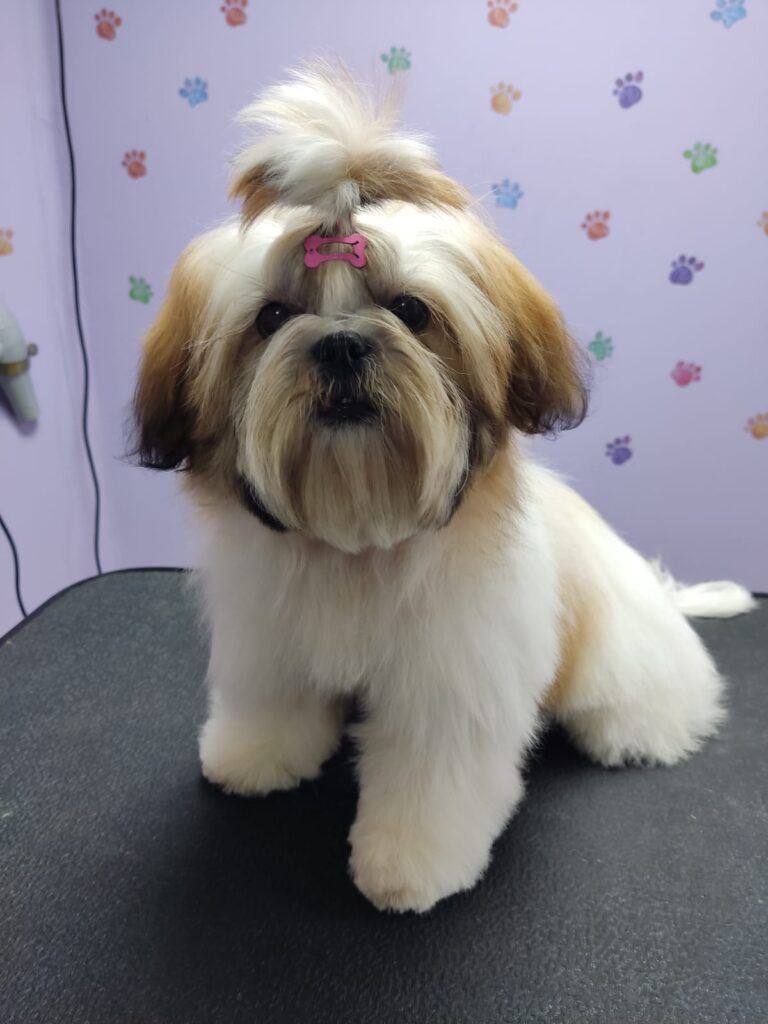
Here one of the test images :
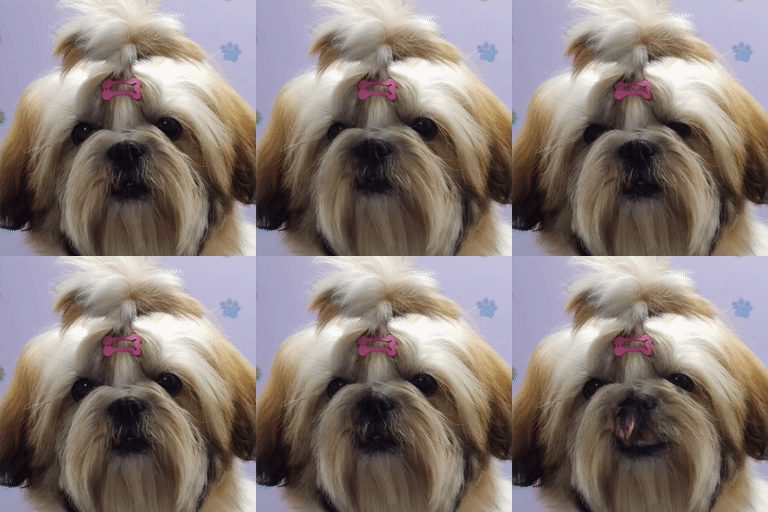
### Run a basic face animation demo using example assets. python inference.py \ -s assets/examples/source/s9.jpg \ -d assets/examples/driving/d0.mp4 ### Animate your own portrait using a custom image. python inference.py \ -s my-Examples/eran.jpg \ -d assets/examples/driving/d12.mp4 ### Enable automatic cropping to improve facial alignment. python inference.py \ -s assets/examples/source/s9.jpg \ -d assets/examples/driving/d13.mp4 \ --flag_crop_driving_video Here is some of the AI Face Animation results :
FAQ
What is AI face animation?
AI face animation transfers facial motion from a video to a still portrait while preserving identity.
Is this the same as face generation?
No. The system focuses on motion mimicry rather than creating new facial identities.
Do I need a GPU?
A GPU is recommended for faster inference and higher-quality animations.
Can I animate animals?
Yes. The project includes animal animation support with extra setup steps.
Is training required?
No training is required because pretrained models are used.
Conclusion
AI face animation opens a powerful new way to animate portraits without losing identity.
By transferring real facial motion onto static images, this approach produces natural and expressive results that feel authentic.
This tutorial demonstrated a complete, code-focused workflow—from environment setup to running inference—making it easy to reproduce and extend.
Whether you are experimenting, building demos, or integrating animation into applications, this pipeline provides a strong foundation for realistic AI-driven portrait animation.
Connect
☕ Buy me a coffee — https://ko-fi.com/eranfeit
🖥️ Email : feitgemel@gmail.com
🤝 Fiverr : https://www.fiverr.com/s/mB3Pbb
Enjoy,
Eran